

Table of Contents
- Why Is Marketing Content Often Underused by Sales?
- What Causes Misalignment Between Marketing and Sales?
- How Can Marketing Deliver a Seamless Content Experience?
- Which Is Better: Sales Enablement Platform or Content Portal?
- How Do Content Portals Drive Strategic Growth?
- Why Should Marketing Lead Sales Enablement Strategically?
- FAQs
In today’s volatile economic landscape, marketing departments in companies often find themselves under pressure. Frequently dismissed as cost centers, they contend with hard-to-measure KPIs and elusive ROI.
Meanwhile, sales teams are hailed as heroes – yet it is marketing that generates demand, and sales that converts it into revenue. Both functions are interdependent and jointly accountable for business outcomes.
Here’s the strategic opportunity: when marketing reimagines Sales Enablement and clearly boosts sales performance, it simultaneously strengthens its position within the organization.
Why Is Marketing Content Often Underused by Sales?
In many firms, the sales process begins with avoidable friction. Updated content for sales teams and partners is often hard to find.
When marketing colleagues are unavailable, sales reps rely on outdated presentations or create their own materials – sometimes using obsolete branding.
The result? A fragmented and inconsistent content experience.
Recent studies highlight the scale of the issue:
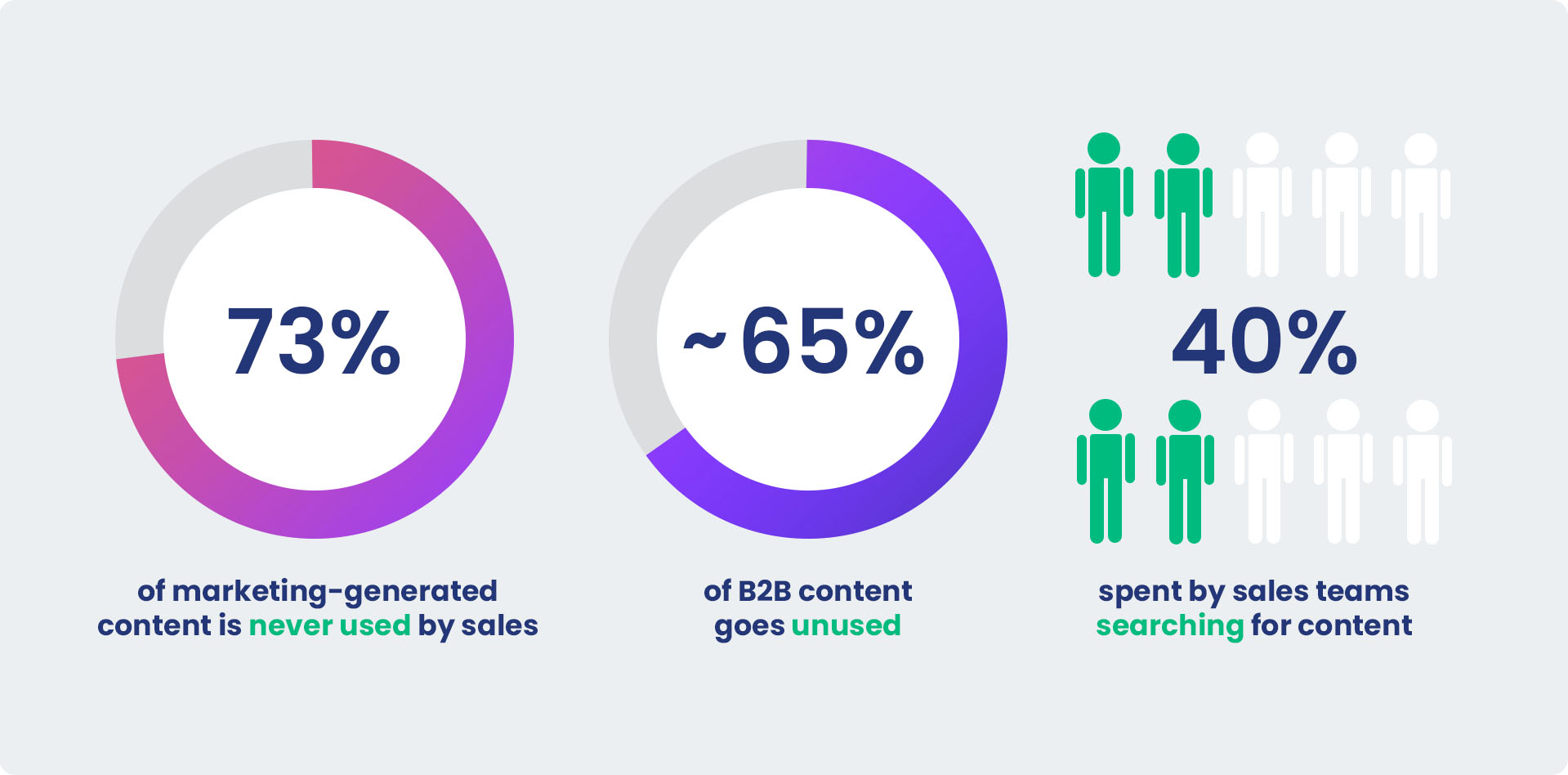
- 73% of marketing-generated content is never used by sales (Highspot).
- 60–70% of B2B content goes unused (Forrester).
- Sales teams spend up to 40% of their time searching for content (CMO Council).
While marketing invests heavily in high-quality assets, sales teams often lose time and opportunities due to limited access to content.
And it’s precisely these materials – case studies, product specs, tailored whitepapers, or compelling visuals – that can make or break a deal.
If content isn’t found, it isn’t used. And ROI? It quietly disappears.

What Causes Misalignment Between Marketing and Sales?
The issue isn’t a lack of commitment from sales or partners. It stems from a legacy of fragmented systems and poor content accessibility.
Marketing teams still rely on manual distribution methods – email lists, shared links, ZIP files, and PowerPoint decks. These tools are inadequate for the complexity of modern B2B communication.
Additional challenges include:
- Content scattered across DAMs, PIMs, SharePoint, cloud storage, and local drives.
- International teams with varying access rights.
- The need to ensure brand consistency across all customer touchpoints.
To overcome these barriers, marketing must rethink Sales Enablement – not as mere file sharing, but as a strategic content experience.

How Can Marketing Deliver a Seamless Content Experience?
In global organizations, it’s not only internal sales teams but also partners, distributors, and resellers who require seamless access to relevant content. The larger the enterprise, the more complex this becomes.
So, the real question is: what systems can help marketing deliver content efficiently, securely, and in a brand-consistent manner?
The answer lies in platform-based solutions. These systems offer scalable, flexible foundations for content delivery without the heavy resource demands of traditional IT projects.
Options range from specialized Sales Enablement platforms to holistic content portals. The key factor isn’t price, but whether the functionality truly fits the purpose.
A modern content experience should offer:
- A Single Source of Truth
- Self-Service Access
- Role-Based Content Delivery
- Consistent Brand Presentation
- Searchable, Filterable, and Shareable Assets

Which Is Better: Sales Enablement Platform or Content Portal?
Choosing the right solution depends on strategic goals.
Sales Enablement Platforms are ideal for supporting complex enterprise sales processes. They offer training, analytics, and CRM integration – making them especially valuable for large sales teams that require ongoing coaching.
While these platforms are long-term investments with high ROI, they also require cross-functional alignment (executive leadership, IT, sales).
Key capabilities include:
- Sales onboarding and training
- Deal intelligence
- CRM-driven content recommendations
- Performance analytics
Content Portals, by contrast, focus on fast, targeted content distribution while ensuring full brand compliance. They bridge the gap between marketing and sales with lean but highly effective features:
- Real-time integration with existing systems
- 24/7 availability
- UX layer for all content
- Granular access control
- Smart search and filtering
- Actionable insights
These portals are easy to implement, integrate with existing data infrastructure, and provide intuitive access for internal and external stakeholders. Their self-service nature can save marketing teams up to 30 hours per month, freeing capacity for strategic initiatives.
Gartner confirms the impact:
“Top-performing companies reduce sales cycles by 20% through improved content access.”

How Do Content Portals Drive Strategic Growth?
A content portal is not just another channel to manage – it’s a strategic lever for growth, brand governance, and sales productivity.
Companies using content portals report measurable activation of sales teams and partners, which translates into long-term revenue growth.
Additional benefits include:
- Stronger alignment between marketing and sales
- Reduced workload through self-service capabilities
- Enhanced global brand consistency
- Foundation for data-driven optimization

Why Should Marketing Lead Sales Enablement Strategically?
The data speaks for itself:
- 60–70% of marketing content goes unused (Forrester)
- Sales teams spend 280 hours/year searching for content (Gartner)
- Leading companies reduce sales cycles by 20% through better content access (Gartner)
Marketing has a unique opportunity to evolve from a cost center into a strategic enabler. By delivering targeted, brand-consistent, user-centric content, it eliminates bottlenecks and boosts sales productivity.
Content portals play a pivotal role – as UX layers over existing systems, self-service platforms for global teams, and drivers of brand-aligned growth.
Marketing departments that invest in the right infrastructure today will not only be more strategically positioned – they will also be significantly more effective tomorrow.
FAQs
Read more



Grow your knowledge
Join hundreds of marketing and brand professionals. Keep up-to-date with the hottest news regarding content portals, brand experience, and digital touchpoints. Don’t miss out!